
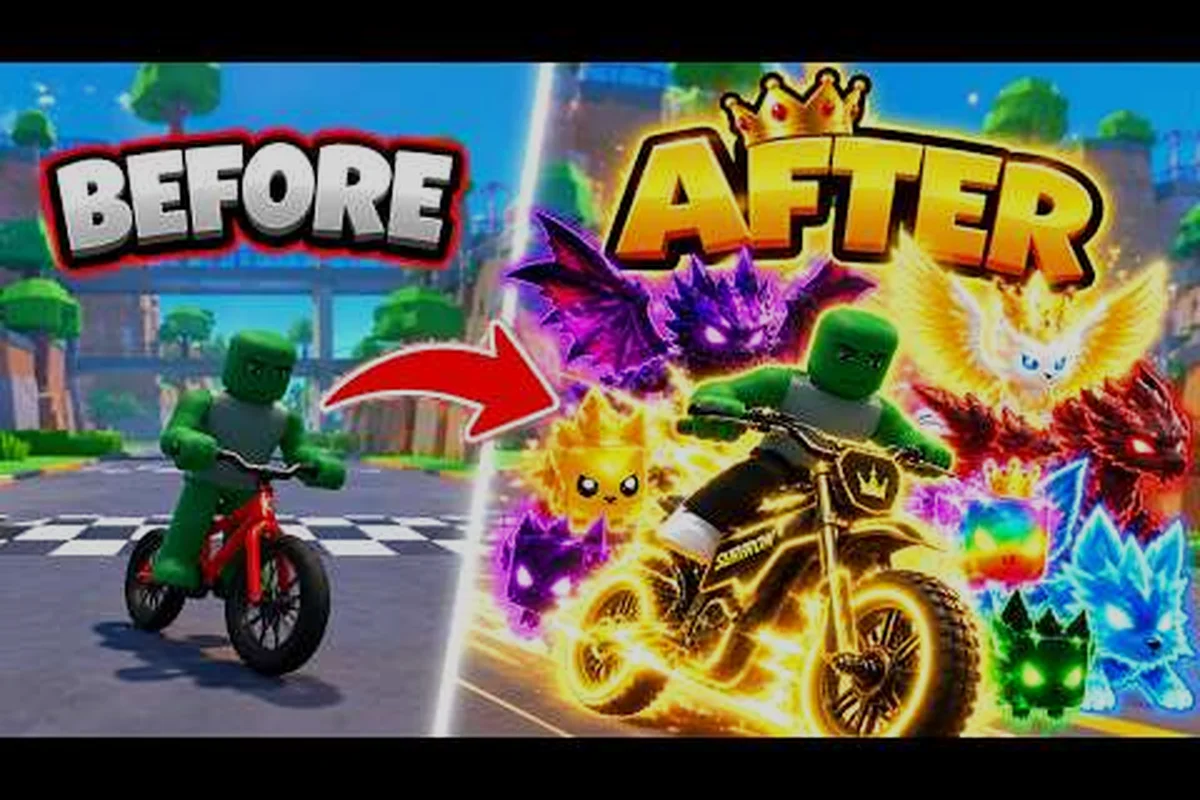
The Bike For Egg! noob to pro climb is really a money curve, and every milestone you hit early decides how fast the rest of your run snowballs. This route walks you from your first stolen egg to the passive-income loops that keep cash flowing without constant grinding.
Most new players stall because they buy cosmetics before their income engine exists, then wonder why every upgrade feels out of reach. The fix is order, not effort: stack speed, hatch aggressively, and only spend on bikes once your pets are already paying you. That sequence is what separates a two-hour pro run from a week of slow scraping, and the community playthroughs below confirm it holds up in practice.
Understanding the Noob to Pro Money Curve in Bike For Egg!
Progression in Bike For Egg! follows three distinct income phases, and each one has a different bottleneck. Early on, your bottleneck is movement speed — you cannot steal eggs or reach farm spots fast enough to matter. Mid-game, the bottleneck shifts to pet income per second, because your collection is wide but shallow. Late-game, the bottleneck becomes upgrade efficiency, where every dollar should feed a multiplier rather than a one-off stat bump.
Community runs document this arc clearly. The YoneK playthrough that goes from fresh noob to master account shows the early steal-egg route feeding directly into pet hatching for passive income, with Speed training as the connective tissue between phases. nabelblox's speedrun-style run reaches the same conclusion from a different angle: prioritize treadmill speed, hatch aggressively, and roll money-per-second before touching bikes or cosmetics. Two independent runs, one shared milestone order.
| Phase | Primary Bottleneck | Best Action | What to Avoid |
|---|---|---|---|
| Early (0–15 min) | Movement speed | Treadmill training, first steals | Buying bikes or skins |
| Mid (15–60 min) | Pet income per second | Aggressive hatching, duplicate stacking | Spreading coins across many weak pets |
| Late (60 min+) | Upgrade efficiency | Multiplier upgrades, mutation hunting | One-off stat purchases |
The practical takeaway is that your first 15 minutes should contain zero cosmetic spending. Every coin goes into speed or eggs, because those two inputs compound while a bike skin does not. Players who internalize this single rule typically cut their early-game time roughly in half compared to friends who buy the flashy item first.
Why Speed Multiplies Every Other Action
Speed is the multiplier on every other action in the game. A faster player steals more eggs per minute, reaches farm spots sooner, and escapes pursuit more reliably. According to community reports, treadmill time is the single highest-return investment in the first session, which is why both major noob-to-pro videos open with it rather than with hatching.
Think of it as a throughput problem. If your steal rate doubles, your hatch rate doubles, and your pet income doubles shortly after. Nothing else in the early game offers that kind of compounding, and no bike purchase can replicate it because bikes affect travel, not action speed.
Bike For Egg Money Making Guide: The First 15 Minutes
Your opening sequence should be mechanical, not exploratory. The goal is to leave the first quarter-hour with a trained speed stat, a handful of stolen eggs, and at least one pet already generating income. Anything else is a detour. Treat the first fifteen minutes as a script you can repeat on any fresh account, because every minute spent wandering is a minute your eventual income engine is not yet running.
Here is the exact order that community runs follow, and the logic behind it is simple: speed makes steals faster, stolen eggs fund the pets, and those pets turn idle time into cash even when you step away from the keyboard for a stretch:
-
Train speed on the treadmill until movement feels responsive rather than sluggish.
-
Steal eggs from sleeping pets — the safest early source, since owners are offline or idle.
-
Hatch immediately rather than hoarding eggs, because income starts the moment a pet exists.
-
Equip your highest earn-rate pet and leave the rest in your collection for later stacking.
-
Reinvest every coin into more speed or more eggs until the first passive trickle appears.
The gamer play noob-to-pro challenge captures this same opening: movement controls first, then stealing from sleeping pets, then first hatch pulls, with the treadmill's role in raising Speed for the full map treated as the backbone of the run. If you want a deeper breakdown of the steal timing itself, the guide on how to hatch eggs fast with quick steals covers the approach windows and safe targets in detail.
| Minute Mark | Target State | Cash Expectation |
|---|---|---|
| 0–3 | Speed trained, controls learned | Near zero |
| 3–8 | 3–5 eggs stolen and hatched | First small trickle |
| 8–12 | Best pet equipped, duplicates stored | Steady low income |
| 12–15 | First reinvestment into speed or eggs | Income climbing |
Reading Your First Income Numbers
Once a pet is equipped, watch the money-per-second figure rather than your total balance. A rising per-second number means your engine works; a flat one means you are holding the wrong pet or too few of them. New players often stare at the total and feel rich, then wonder why the next upgrade takes forever.
Bike For Egg How to Earn Money Fast: Mid-Game Farming Loops
Mid-game is where the Bike For Egg money making guide stops being about individual actions and becomes about loops. A loop is a repeatable circuit — steal, hatch, equip, reinvest — that you can run without thinking. The players who climb fastest are not doing anything exotic; they are running a tighter loop with fewer wasted trips.
The core mid-game loop looks like this, and the point of the shape is that every leg of it generates either eggs or income, so a failed steal on one leg rarely zeroes out the whole cycle — you just reroute and rejoin the loop:
-
Steal in batches rather than one egg at a time, so travel cost amortizes across several pulls.
-
Hatch in batches too, because a run of ten hatches gives you a much clearer read on your pull quality than a single lucky egg.
-
Equip by earn rate, not by rarity, since a common pet with a strong multiplier can outperform a rare one sitting idle.
-
Bank duplicates for mutation and size upgrades instead of selling them off cheaply.
The AURA THY arc video — the community's most-quoted run — tracks a beginner chicken all the way to a Divine Unicorn in a single progression, which is a useful illustration of how mid-game income compounds once duplicates and mutations start stacking. That jump does not come from one lucky hatch; it comes from hundreds of looped pulls funded by a working income base.
| Loop Type | Time Cost | Income Profile | Best For |
|---|---|---|---|
| Single steal + hatch | Low | Slow, steady | Learning the map |
| Batched steal (5+) | Medium | Faster, scalable | Mid-game grinding |
| Mutation hunting | High | Spiky, high ceiling | Late-game pushes |
| Passive idle collection | None | Flat trickle | Overnight or AFK |
When to Switch From Active to Passive
The moment your passive income covers a meaningful upgrade every few minutes, you can afford to slow down and hunt for quality instead of quantity. That threshold varies by account, but a good rule is to switch once a single upgrade costs less than five minutes of idle earnings.
Bike For Egg Best Ways to Farm: Choosing Your Route
Not every farm route suits every account, and the best ways to farm in Bike For Egg! depend on how much time you have and how strong your pet collection already is. Short sessions favor dense, high-traffic steal spots where you can pull several eggs quickly. Long sessions favor routes that combine stealing with mutation opportunities so each trip does double duty.
| Route Style | Session Length | Strength Required | Yield |
|---|---|---|---|
| Dense steal cluster | 10–20 min | Low | High volume, low quality |
| Mixed steal + mutation | 30–60 min | Medium | Balanced |
| Rare-target camping | 60+ min | High | Low volume, high ceiling |
| Idle passive setup | Any | Medium | Flat, hands-off |
If your goal is raw cash in the shortest window, the dense cluster wins almost every time. If your goal is a specific high-value pet, camping beats volume because each pull carries more upside. The mistake is running a camping route on a weak account — you will spend an hour for one pull that a stronger player would have gotten in ten minutes.
Matching the Route to Your Bike
Bike choice quietly shapes which routes are viable, because travel time between clusters is a real cost. Faster bikes make spread-out routes practical, while slower bikes push you toward tight loops. The breakdown of best bike upgrades and shop priority explains which purchases actually shorten your route time versus which ones just look good in the garage.
Bike For Egg How to Get Money: Late-Game Multipliers
Once your income base is stable, growth comes from multipliers rather than volume. This is the phase where the noob to pro gap becomes obvious: experienced players stop adding pets and start multiplying the ones they have. Mutations, size bonuses, and upgrade stacking all fall into this category, and each one changes your earnings without requiring more playtime.
The size chart matters here more than most players expect. Larger pets and mutation effects do not just look impressive — they change the earn rate attached to a pet you already own, which means your existing collection becomes more valuable without any new hatches. The full size chart and mutation value breakdown lays out which combinations actually move the needle and which are cosmetic noise.
| Multiplier Source | Effort to Obtain | Income Impact | Priority |
|---|---|---|---|
| Mutation rolls | Medium | High | Top |
| Size upgrades | Medium | Medium–High | High |
| Duplicate stacking | Low | Medium | Medium |
| Cosmetic variants | Low | None | Skip |
The Reinvestment Rule That Keeps You Climbing
Every time your balance crosses an upgrade threshold, spend it. Sitting on cash is the single most common late-game stall, because unspent money earns nothing while an upgrade compounds for the rest of the session. Treat your balance as a queue of pending upgrades rather than a score to protect.
Common Noob Mistakes That Slow Your Money Down
Most slow runs share the same handful of errors, and each one is fixable within a single session. The pattern across community playthroughs is consistent: players who stall are almost always spending in the wrong order rather than playing too little.
-
Buying a bike before income exists — travel speed helps, but only after you have something worth traveling to.
-
Hoarding eggs instead of hatching — an unhatched egg earns nothing, and the hatch is where value appears.
-
Equipping by rarity instead of earn rate — the flashier pet is not always the better earner.
-
Ignoring duplicates — stacked duplicates feed mutation and size upgrades that multiply your whole collection.
-
Running a camping route on a weak account — high-ceiling routes need the income base to support the time cost.
The fix for all five is the same: check your money-per-second figure before and after any change. If it did not go up, the change was not an upgrade, no matter how good it looked in the shop. Apply the same test to eggs, pets, and bike purchases alike, and you will catch the marginal buys that stall most mid-game accounts before they cost you a session.
A Quick Sanity Check Before Every Purchase
Ask two questions. First, does this raise my per-second income or my action speed? Second, will this still matter in twenty minutes? If both answers are yes, buy it. If either is no, keep the coins and run another loop instead.
Frequently Asked Questions
How long does it take to go from noob to pro in Bike For Egg!?
Community speedruns complete the full arc in a single sitting, often under two hours, because the milestone order is short once you know it. Casual players who follow the same sequence — speed first, hatching second, bikes last — typically reach a stable income base within one or two sessions.
What should I buy first in Bike For Egg!?
Nothing from the shop. Your first coins belong to treadmill speed and egg acquisition, since both compound into every later action. Bikes and cosmetics come after your pets are already generating passive income, which is the point where travel upgrades actually pay for themselves.
Is stealing eggs better than hatching your own?
Stealing from sleeping pets is the fastest early source because it costs no waiting time and targets are usually idle. Once your income base exists, mixing steals with your own hatches keeps the loop tight, and the full pet list and rarity breakdown helps you decide which pulls are worth chasing.
What are the best ways to farm money in Bike For Egg!?
Dense steal clusters win for raw volume in short sessions, while mixed steal-and-mutation routes pay better over an hour of play. Match the route to your account strength: weak accounts should farm volume, and strong accounts should camp high-value targets where each pull carries real upside.
Do mutations really increase my income?
Yes, and they are the top late-game multiplier because they raise the earn rate on pets you already own. That means no new hatches are required to benefit, which is why experienced players prioritize mutation rolls over adding more pets to an already-wide collection.
The whole noob to pro path in Bike For Egg! comes down to sequencing: train speed, steal and hatch in batches, equip by earn rate, and only then spend on bikes and multipliers. Each phase funds the next, and the players who climb fastest are simply the ones who refuse to skip a step. Run the loop, watch your per-second number, and let the compounding do the work.